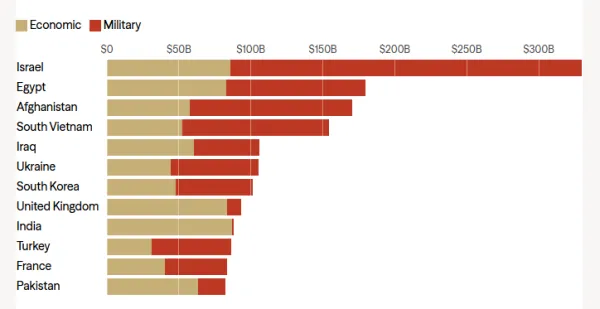
Israel Is the Largest Cumulative Recipient of U.S. Aid Since 1948. US provided Israel $3.8 billion per year, that is $10 million dollar/day. Sources: Foreignassistance.gov; Congressional Research Service.
According to the Council on Foreign Relations, the United States has provided more than $300 billion in total economic and military assistance to Israel since 1948, when adjusted for inflation. That breaks down to roughly $10 million a day—money that could have gone toward programs like Head Start or food assistance for Americans in need, such as veterans and homeless. Instead, we are being asked to tighten our belts for the sake of a foreign nation.
In 2015, the U.S. Congress cut $5 billion from the Food Stamps Program. At the same time, lawmakers approved $488 million in aid to Israel. Syndicated columnist Patrick Buchanan once remarked that Congress is “Israeli‑occupied territory,” a comment he made after serving as a political advisor in the Nixon, Ford, and Reagan administrations.
U.S. lawmakers often forgive loans to Israel. Any U.S. aid that is not repaid on time results in American taxpayers covering the late fees. This is one of the most bizarre policies I have ever heard of. Why does Congress bend over backward to accommodate a foreign nation? It is time to remind those in Congress who prioritize Israel that charity begins at home—and that America should come first.
There is no reason the U.S. government should subsidize healthcare for Israelis while American veterans struggle to access the care they earned. Israel has a population of approximately 8.7 million—roughly equal to New Jersey—and is among the world’s most affluent nations, with a per‑capita income slightly below that of the European Union. Israel’s unemployment rate of 4.3% is better than America’s 4.4%, and its net trade, earnings, and payments rank 22nd in the world, while the U.S. sits at a dismal 202nd.
Yet Israel receives more of America’s foreign aid budget than any other nation. In fact, the U.S. has given more aid to Israel than to all the countries of sub‑Saharan Africa, Latin America, and the Caribbean combined regions with a total population of over one billion people. (Source: If Americans Knew)
As the war with Iran puts renewed focus on America’s relationship with Israel, one question keeps coming up: How much U.S. taxpayer money has gone toward supporting Israel, and what restrictions—if any—come with it?
The Scale of U.S. Aid to Israel
The 2019–2028 Memorandum of Understanding, signed during the Obama administration, commits the U.S. to $38 billion over ten years—$33 billion in Foreign Military Financing (FMF) and $5 billion for missile defense systems.
According to the U.S. Department of State, this amounts to roughly $3.3 billion annually in military aid, plus $500 million per year for missile defense, bringing the total to about $3.8 billion annually.
U.S. Law: The Leahy Act
Under the Leahy Law, the U.S. is prohibited from providing military assistance to foreign security units credibly accused of gross human rights violations. However, the Council on Foreign Relations notes that some legal scholars and critics argue the law has not been applied to Israel in the same way it has been applied to other countries.
Israel’s Social Benefits vs. America’s
Israel is considered a high‑income, advanced economy with a strong technology sector. It also maintains a more robust baseline of social benefits than the U.S. According to the Commonwealth Fund, Israel provides universal healthcare to all citizens and permanent residents under its national health insurance system.
In addition, Israeli citizens have access to free K–12 education, child allowances, unemployment benefits, and national pension programs, supported through a centralized social insurance system.
Meanwhile, Americans are told that Social Security and Medicare need to be cut. And now, laws are being proposed that would criminalize criticism of Israel. That is not democracy—it is foreign‑policy capture. U.S. citizens have more freedom to criticize their own government than the one they are subsidizing.
U.S. aid to Israel since 1949—including direct grants, loan guarantees, and interest payments—places the average per‑taxpayer burden at well over $1,200 in real terms.
War With Iran
We are now bombing Iran in ways that align with Israeli strategic interests, even though Israel—armed with nuclear weapons—provides universal healthcare and subsidized higher education for its citizens, while the U.S. is $37 trillion in debt.
Why I Want Reparations
My reasons are personal as well as political:
- My late father and my late younger brother were both held hostage by the IDF in 1948 and 1982, respectively. They were not combatants. They were innocent bystanders taken solely because they were Palestinian. My father had returned to his village in Palestine from Lebanon after the Nakba to search for his mother and older brother, from whom he had been separated.
- My younger brother was visiting our mother in a Palestinian refugee camp in Lebanon shortly before the 1982 Israeli invasion. During the occupation, Israeli forces detained every male Palestinian of fighting age. He was held for 18 months and released only through a prisoner exchange. Had the PLO not captured nine Israeli soldiers, my brother might have remained in captivity indefinitely.
- Finally, as a patriotic American, I have fulfilled every civic duty asked of me:
- I paid my taxes.
- I voted in every election.
- I served in the U.S. military.
- I even served on jury duty.
Mahmoud El‑Yousseph is a Palestinian freelance writer and retired U.S. Air Force veteran. He writes on U.S. foreign policy, Middle East affairs, and justice. Email: elyousseph6@yahoo.com